Brass Plates and Black Doors: Navigating London's Clubland by Chauffeur in 2026
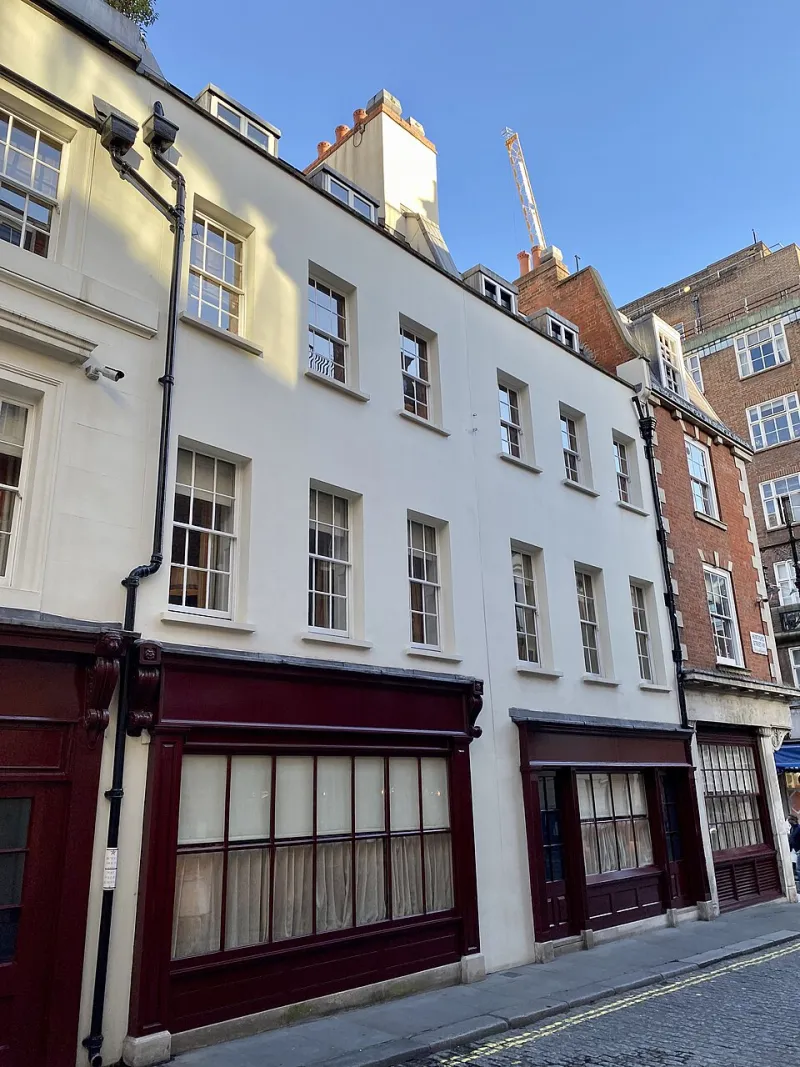
Photo: No Swan So Fine, CC BY-SA 4.0, via Wikimedia Commons
Every private members' club in London is, at street level, a door. Sometimes it is a handsome Georgian door with a brass plate and a single bell; sometimes it is a canopy, a step and a doorman in a long coat. The difference between a graceful arrival and a clumsy one is almost never the car. It is the thirty seconds around that door.
Why the approach matters more than the arrival
A guest who steps from a chauffeured car at the right moment, on the right side of the street, with a doorman already expecting them, feels the evening begin properly. A guest who steps out into a queue of traffic on a one-way street while the driver searches for somewhere to stop feels the reverse. Clubland's geography — the narrow streets of Mayfair, the gentlemen's-club quarter of St James's, the single-flow lanes around Covent Garden — rewards a driver who knows the block, not merely the postcode.
The approach: doors, kerbs and one-way streets
Mayfair's club streets are short and frequently one-way. Berkeley Square, Albemarle Street, Dover Street, Charles Street, Mount Street, South Audley Street and West Halkin Street all have their own temperaments, and several have residents' bays that a car must not occupy even briefly. The practised method is to identify the drop point before the journey, not on arrival: which side of the road the entrance sits on, whether the door opens onto pavement or a crossing, whether the club's doorman prefers vehicles to draw up at the door or a few yards beyond it.
Where a street is too tight to linger — and several are — we stop only long enough to open the door, hand down the guest and close it. Luggage, umbrellas and outerwear travel in the car; the pavement is not a place for assembling one's belongings.
Discretion is a strategy, not an attitude
Chauffeurs understand that a private members' club exists to be private, and that an idling car at the kerb is the opposite of discretion. Engines are off in electric vehicles in any case; in hybrid and conventional cars they are switched off at the earliest moment, which also keeps us clear of the idling penalties enforced in several central boroughs.
Waiting is planned rather than improvised. Rather than circling Berkeley Square or holding a bay outside a club for two hours, the car is positioned at a known quiet point — the perimeter of Grosvenor Square, the approach to Hyde Park, a legal bay a short drive away — and the return is timed to a message from the doorman or the guest. When a party leaves at midnight and three cars are needed, the sequence is arranged in advance so that no convoy of identical vehicles blocks the street.
The jacket question, and the timing of it
Most traditional clubs still expect a jacket for men in the principal rooms, and several ask for a tie at dinner; some of the newer Mayfair houses are relaxed after a certain hour but firm before it. The practical consequence for a chauffeur is that garments should travel in the car, hung rather than folded, and that the change can be made in the minutes before arrival.
We build that into the schedule. A guest leaving an office at half past six with a seven-forty-five dinner reservation has time to change in the car — a partition, a hanger and a mirror are small courtesies that make a considerable difference — or to use the club's cloakroom on arrival. What guests should not do is arrive at the door in a state of adjustment. The doorman will wait; the tailoring will not forgive being rushed.
Handling guests who are not your own
Much of clubland's chauffeur work involves collecting other people: a client's guests from a hotel, a colleague from a station, a spouse from a gallery. Three courtesies cover most of it.
- Name cards stay discreet. A card in the window at waist height, not a placard raised above the roofline. In a residential square, loud greetings are unwelcome.
- Arrive before you are expected. A car already waiting is a reassurance; a car that arrives while the guest is standing on the pavement is a small failure.
- Sequence the party. If two cars are carrying one dinner, the second should be two minutes behind the first, not attached to its bumper. Clubs handle a steady trickle of arrivals elegantly; they handle crowds less so.
A worked evening, Berkeley Square to Belgravia
Consider a representative evening. A car collects at half past six from a house near Mount Street and delivers to a club on Berkeley Square for an aperitif — a journey of four minutes that is worth taking for the sake of a coat and a calm arrival. At a quarter past eight the party moves to dinner in West Halkin Street, again a short hop; the car waits nearby rather than at the door, since the street will not accommodate it. By half past ten a nightcap is proposed somewhere on Albemarle Street, and by half past twelve the party is returned to Eaton Square, with the car holding only long enough for the front door to open.
Nothing in that evening is remarkable except that it works. The distances are trivial; the timing is not.
Beyond Mayfair: the wider circuit
The same principles travel. In St James's, the great clubs of Pall Mall and St James's Street — the Reform, the Athenaeum, Brooks's, White's, Pratt's in Park Place — sit on streets where a car must be brisker still. Towards Covent Garden, the Garrick and the newer houses around the Piazza demand a driver who understands theatre traffic and the pedestrianisation of the surrounding lanes. Across to Shoreditch or the City, the rules loosen but the courtesy does not: a discreet stop, a door held, a car that leaves rather than lingers.
The last word on the door
Clubland has survived for three centuries by preferring the understated to the elaborate. A chauffeured arrival should follow the same instinct: punctual, quiet, and gone before anyone has cause to remark upon it. The finest compliment a chauffeur can receive at a club door is not a thank-you. It is that nobody noticed the car at all.