Silence as a Service: The Electric Chauffeur's Place in Central London, 2026
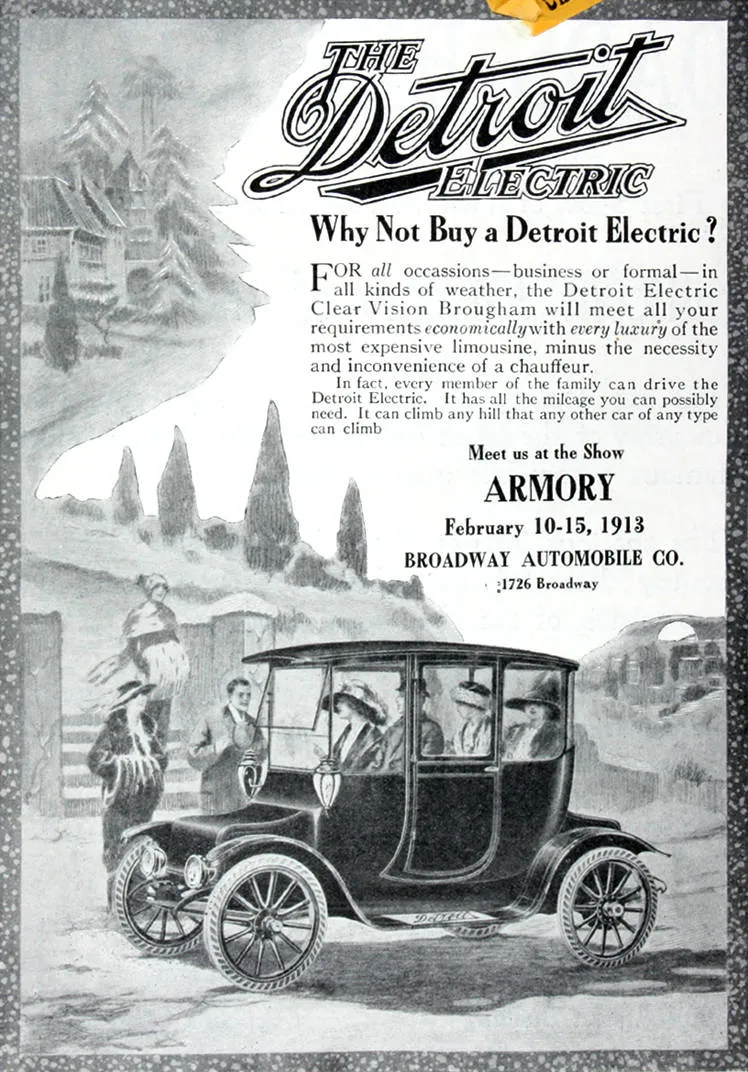
Photo: Anderson Electric Car Company, Public domain, via Wikimedia Commons
There is a particular sound that a chauffeured car makes outside a Mayfair hotel at half past six in the morning: a low diesel idle, held at the kerb while luggage is stowed and a door is held open. In 2026, a growing number of our journeys make no sound at all. That shift — modest in engineering terms, considerable in atmosphere — is the subject of this piece.
The arrival begins at the kerb
A chauffeured journey is judged long before the vehicle moves. It is judged at the moment the car draws up: how it sounds, what it leaves behind, and how the guest feels stepping onto the pavement. An electric saloon or MPV at a Berkeley Square entrance in the early morning disturbs no residents behind their shutters. It adds nothing to the air in a street already thick with taxis. The doorman hears the door rather than the engine, and the luggage is loaded without raising voices.
For guests arriving off an overnight flight into Heathrow, that quietness has a practical value. The cabin is already at temperature before departure, the windows stay clear without an idling engine, and a call can be taken on the way into town without a background hum. Executives who use the car as an extension of the working day notice this before they notice anything else.
What the regulations now require of us
London's charging regime has settled into a shape that clients should understand, because it affects the cost of a booking and, occasionally, the choice of vehicle.
- The Ultra Low Emission Zone now reaches the capital's boundaries. A compliant electric car pays nothing; a non-compliant older diesel or petrol car pays a daily charge.
- The Congestion Charge applies across Mayfair, St James's and the City. It rose to £18 a day in January 2026, and the Cleaner Vehicle Discount for electric cars ended on 24 December 2025. Put plainly: an electric car is no longer exempt from the Congestion Charge. Any quotation that implies otherwise is out of date.
- Vehicle excise duty now applies to electric cars as it does to others, and idling enforcement continues in several central boroughs, with fixed penalties for engines left running at the kerb — a rule that an electric car simply sidesteps.
The upshot is that the environmental case for electric is stronger than ever and the fiscal case is narrower than it was. We quote both honestly.
The charging rhythm behind a smooth transfer
The question clients ask most often is whether an electric car can reliably manage an airport run. It can, and without drama, provided the day is planned rather than improvised.
A return journey between Mayfair and Heathrow is generally in the region of forty miles; Gatwick and Luton rather more, but still within the comfortable range of a modern executive EV. Our rhythm is straightforward: the car returns to its charging point overnight and leaves fully charged; longer waits at the airport are used for a top-up rather than an idle hour in a car park; and the diary is built so that a charge never sits between a guest and a departure. Where a client's schedule is unusually tight or unpredictable, a hybrid is dispatched instead.
Where the electric car is now the more elegant choice
Within the North and South Circular, the EV wins on almost every count that matters to a discerning passenger. It is quieter in traffic, smoother from a standstill, and considerably more restful over the stop-start crawl along Piccadilly or the Strand. For hotel arrivals, theatre transfers, club dinners, shopping circuits and the short hop between Mayfair and the City, it is the vehicle we would choose ourselves.
It is also the better neighbour. Hotel forecourts on Park Lane and in Mayfair are sensitive to fumes and noise, and a number of them now quietly prefer electric arrivals. At three in the morning, that preference is easy to understand.
Where it is not — and where we say so
Good chauffeuring is not evangelism. There remain journeys for which a conventional or hybrid vehicle is the more sensible booking, and we will recommend one without being asked.
The clearest cases are long-distance runs with fixed appointments: Edinburgh, the Lake District, north Norfolk, west Cornwall. A hybrid removes any dependence on the rapid-charging network in rural areas, where a queue at a motorway services charger can cost an hour that a client's diary cannot spare. Similarly, journeys involving heavy luggage, several passengers and multiple stops across a day are better served by a large hybrid estate or MPV. And where a guest intends to work continuously in the car for three hours, the absence of a charging stop is itself a comfort.
For a Cotswolds day trip or a run down to a Hampshire wedding, the electric car is entirely at ease. For a 400-mile day, it is not the tool we would reach for.
The quiet conclusion
Electric chauffeuring in London in 2026 is no longer a statement; it is a preference, and usually a sensible one. It buys silence at the kerb, cleaner air outside the hotel, and a calmer cabin for the passenger who needs to arrive composed. It does not exempt anyone from the Congestion Charge, and it does not suit every journey on the calendar.
That, in the end, is the whole case for a chauffeur service rather than a car: the judgement about which vehicle suits which day. The silence is simply a welcome consequence.