The Invisible Ground Segment: Private-Jet Arrivals from Farnborough and Luton to Mayfair

Photo: Stratajet, Public domain, via Wikimedia Commons
The Final Mile Is Not a Footnote
Private aviation sells a version of time that commercial flying cannot: the car to the apron, the short walk to the cabin, the absence of queues. Yet the journey does not end at the aircraft door. The final segment — from Farnborough or Luton to Mayfair — is where the promise is either kept or quietly broken. A private jet can arrive precisely on schedule and still produce a frustrated passenger if the ground team has been booked as an afterthought.
For the discerning traveller, the ground segment is not merely transport. It is the first impression of London, the buffer between flight and obligation, and the point at which discretion must be absolute. In 2026, the difference between a competent airport transfer and a genuinely seamless private-jet handover lies in preparation that the passenger should never need to see.
Two Airfields, One Standard
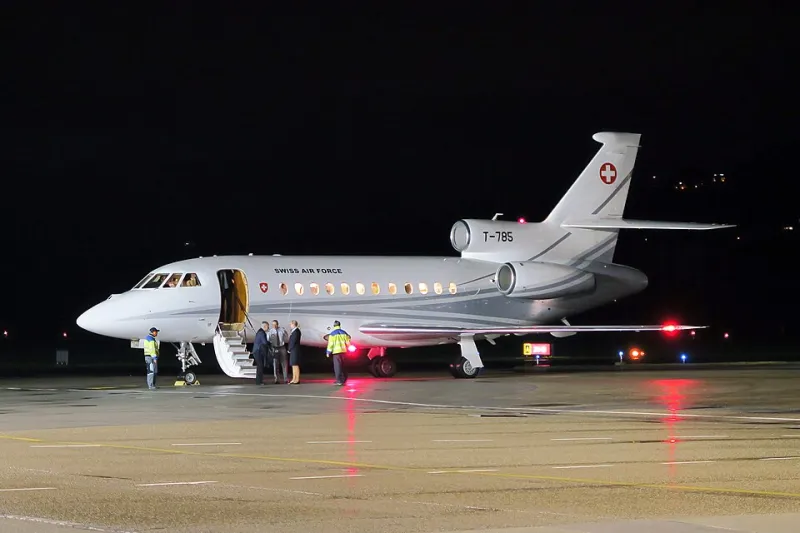
Farnborough and Luton serve different parts of the private-aviation map, and a chauffeur team should treat them as distinct operations rather than generic airport pickups. Farnborough, in Hampshire, is synonymous with business aviation: a dedicated airport with a calm, low-profile terminal environment and apron access that feels a world away from the commercial concourse. Luton, by contrast, is a busy international airport with a separate private-aviation terminal; the atmosphere is efficient but more compressed, and the distinction between the private terminal and the main terminal is critical.
A driver who has been told only to meet a passenger at Luton may arrive at the wrong building. A driver who knows the FBO, the tail number and the expected arrival slot can position the vehicle at the correct door, with the correct luggage capacity, before the aircraft has finished taxiing. That distinction — between a booking and a brief — is the heart of operational luxury.
The Pre-Arrival Brief
A chauffeur team cannot improvise a private-jet handover. The pre-arrival brief should include the passenger names, the aircraft tail number, the arrival airport and FBO, the estimated landing time, the number and type of cases, the preferred vehicle class, and the onward addresses in Mayfair. If the passenger is proceeding to a hotel, the hotel forecourt protocol should be confirmed. If the destination is a private residence, the access arrangements should be scouted in advance.
Discretion must also be specified rather than assumed. Some passengers appreciate a name board; many do not. Some prefer a chauffeur in a suit at the FBO entrance; others prefer the driver to remain with the vehicle until the passenger is ready. A single point of contact — one operations manager who holds the brief and can communicate with the FBO, the crew and the passenger — removes the risk of contradictory instructions. The objective is not to impress with activity but to remove friction so completely that the handover feels unmanaged.
Luggage, Border Control and the Handover
Private-jet passengers often travel with more luggage than the cabin suggests: ski equipment, hunting rifles in season, presentation materials, multiple cases for a short stay. Vehicle choice should be dictated by volume as much as by prestige. A Mercedes-Benz S-Class is ideal for two passengers with light luggage; a V-Class or a Range Rover may be the more sensible choice for a family, a security detail or a longer stay. The finest vehicle is the one that does not require a second trip.
The FBO will manage customs and immigration, and the chauffeur team should work with that rhythm rather than against it. Border control is not a process to be rushed, and a driver who understands the likely clearance time can avoid the twin errors of arriving too early and creating a visible wait, or arriving too late and leaving the passenger stranded. Once clearance is complete, luggage should move directly from the FBO to the vehicle under the chauffeur's supervision. The passenger should be invited to settle into the cabin while the practical work happens outside it.
Vehicle Choice and the Mayfair Arrival
The route from Farnborough or Luton to Mayfair is familiar to any experienced London chauffeur, but familiarity should not breed complacency. Traffic conditions, roadworks, events and the congestion charge zone all affect the arrival. A private-jet passenger may have a dinner reservation at Scott's, a fitting at Huntsman, or a meeting in Grosvenor Square; the chauffeur should know which approach to Mayfair best serves the next obligation. The drop-off at Claridge's, The Berkeley or Grosvenor House is not the same as a discreet arrival at a private address on Mount Street.
Mayfair's streets are elegant but unforgiving. A larger vehicle may need a carefully chosen approach; a hotel forecourt may require advance notice; a residential address may offer no more than a narrow stretch of kerb. The chauffeur should be prepared to handle the final fifty yards as thoughtfully as the final fifty miles. That is where the passenger's experience of London begins, and it should feel unhurried.
When the Schedule Moves
Private aviation is flexible, but it is not immune to weather, slot restrictions or last-minute changes. A properly briefed chauffeur team will track the flight, maintain contact with the FBO and hold the vehicle on standby without creating anxiety for the passenger. If the arrival is delayed, the vehicle should still be ready. If the passenger decides to divert to a different London address, the team should be able to adapt without a lengthy negotiation.
This is the practical argument for a dedicated chauffeur service rather than a series of ad hoc bookings. The value lies not only in the vehicle but in the operational layer around it: a team that knows the airports, understands the FBO environment, and can make decisions quietly when the schedule shifts.
The Test of Invisibility
The finest private-jet handover is the one the passenger barely notices. There is no search for a driver, no discussion about luggage, no uncertainty about the route, no sense that the ground segment is a separate transaction. The aircraft arrives, the passenger is met, the cases disappear into the vehicle, and Mayfair comes into view with the day still intact.
That is the standard Mayfair Drives Ltd sets for private-aviation clients arriving through Farnborough and Luton. The aircraft may be the headline, but the ground segment is where the service proves itself.