A Civilised Circuit of Light: Chauffeured Christmas London in 2026
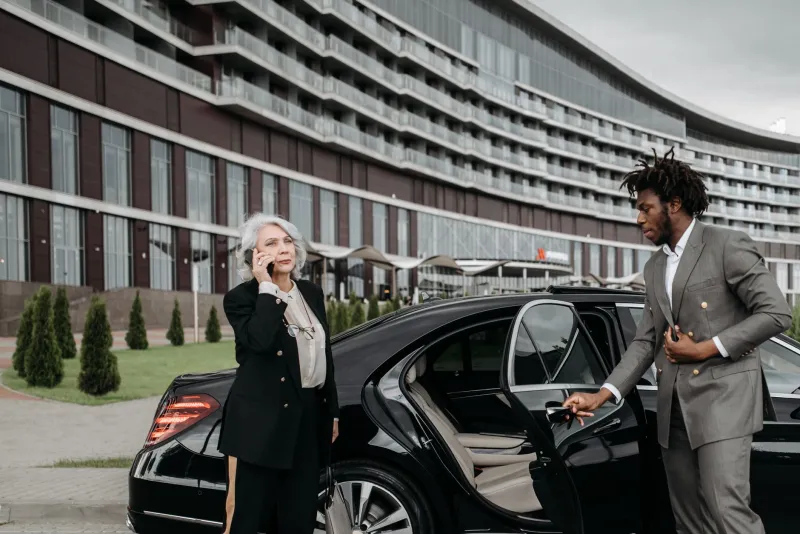
London’s Christmas lights are best understood not as a single destination but as a sequence. For travellers with limited evenings and an aversion to crowd crush, the private car offers a particular advantage: the ability to see the spectacle at its best and retreat before the pavement becomes impassable. This 2026 route begins in Mayfair and ends with a quiet return, taking in Regent Street and Chelsea without treating the evening as a checklist.
Setting Out from Mayfair
Begin after the working day has softened but before the West End fills. A departure from Mayfair at around 16:30 in late November or early December is often well judged: the lights are on, the sky retains a little colour, and the first wave of office departures has not yet become the second wave of diners. The route can start with the quieter residential streets — Mount Street, Grosvenor Square, Berkeley Square — where illuminations are restrained and the car can move at a contemplative pace. This is not the main event, but it sets the tone. In 2026, as in recent years, the most photographed displays reward those who arrive early and leave before the crowd thickens. The chauffeur can hold the car while passengers step out for a short walk, or proceed slowly so that the rear seat becomes a private viewing gallery.
Regent Street at the Right Hour
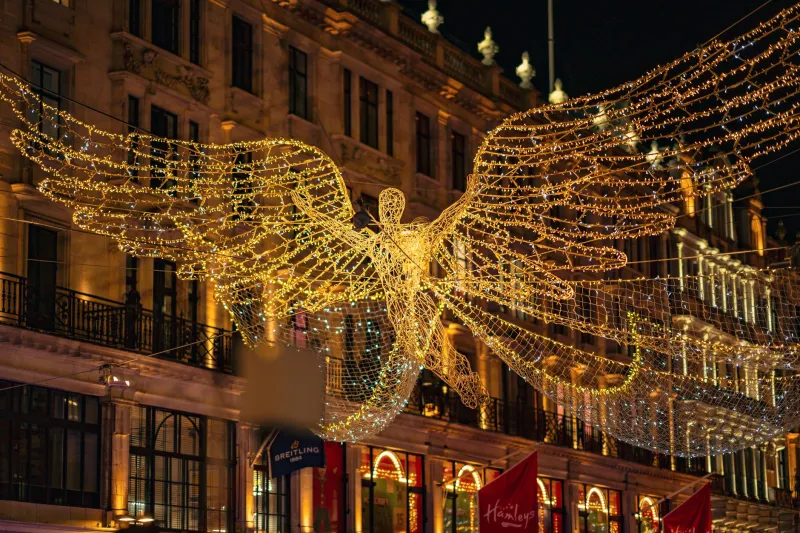
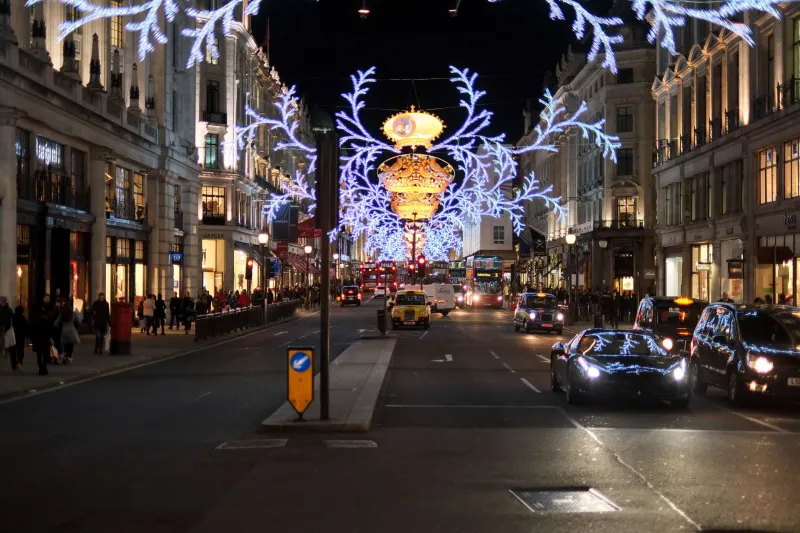
Regent Street remains the ceremonial centre of London’s Christmas lighting. Its great curve is best approached from the north, allowing the display to reveal itself gradually rather than arrive all at once. The sensible aim is to be there before 17:30 on a weeknight, or earlier on a Saturday. After that, the combination of shoppers, sightseers and buses can reduce even a well-planned drive to a crawl. A chauffeur familiar with the side streets can approach from Langham Street or Great Portland Street and position the car for a slow pass rather than a long wait. Passengers may prefer to alight near Oxford Circus and walk a short section on foot, rejoining the car further south. This is the central principle of a good lights tour: the car is not a cage. It is a base from which to step out, and to which to return when the cold or the crowd becomes tiresome. For 2026, it is worth checking whether any section of Regent Street is pedestrianised on the evening in question; the driver can then adjust the route accordingly.
A Pause for Refreshment
A lights tour that lasts more than ninety minutes without a pause is a test of endurance rather than a pleasure. The better evening includes a deliberate interval. A Mayfair hotel drawing room, a members’ club dining room, or a reserved table at a discreet restaurant can provide warmth, a light supper and a chance to reset. For those who prefer to remain in the car, a pre-arranged hamper or a flask of something hot is a reasonable substitute, though the civilised option is to sit down. The refreshment stop should be booked for a time that does not compete with the lights: perhaps 17:00 for an early supper, or 19:30 after the main displays have been seen. In Chelsea, a brasserie or hotel lounge near Sloane Square can serve the same purpose. The chauffeur will wait, and the car will be warm on return. This is the quiet luxury of the private drive: not merely transport, but the removal of friction.
Chelsea and the River
From Regent Street, the route can turn west towards Chelsea. The King’s Road and Sloane Square have a more local, less theatrical atmosphere than the West End, and the riverside stretches offer a different kind of spectacle. A slow pass through Chelsea in 2026 should include the quieter streets around Elizabeth Street, where shopfronts and small trees carry restrained displays, before a final approach towards the river. The Albert Bridge, illuminated after dark, is a natural conclusion. The car can pause on the north bank or cross into Battersea for a different perspective. Here, the advice is simple: do not attempt to stop on the bridge itself. A chauffeur will know the legal and practical places to wait, and the rear-seat view is often better than a pavement scrum. For those who wish to walk, a short stretch of the Chelsea Embankment is manageable, with the car following at a discreet distance.
The Return and the Art of Timing
The final leg should be planned as carefully as the first. By 20:30, central London’s traffic begins to thicken again as diners and theatregoers converge. A return to Mayfair via Belgravia and Hyde Park Corner is usually smoother than retracing the West End. The evening can end with a nightcap at a hotel bar or a quiet drop at a private residence. The point is not to see every installation, but to see enough, in comfort, and to leave with the evening intact. For 2026, the lights will change, the switch-on dates will vary, and the crowds will behave with their usual unpredictability. A chauffeured route provides a framework, not a straitjacket. Booked with a reputable operator such as Mayfair Drives Ltd, it allows the passengers to concentrate on the spectacle, the conversation and the season, while the driving is handled with the discretion that the occasion deserves.