Behind the Glass: The Quiet Conventions of the Chauffeur-Driven Rear Seat
There is no manual for the rear seat. No one hands a passenger a card at the kerb explaining how to behave between Mayfair and Heathrow, and the very best journeys proceed without a single instruction being issued in either direction. What exists instead is a body of habit — part courtesy, part choreography — understood by those who travel this way often and absorbed quickly by those who do not. This is not a rulebook. It is simply an account of how the smoothest journeys tend to unfold.
The appointment at the kerb
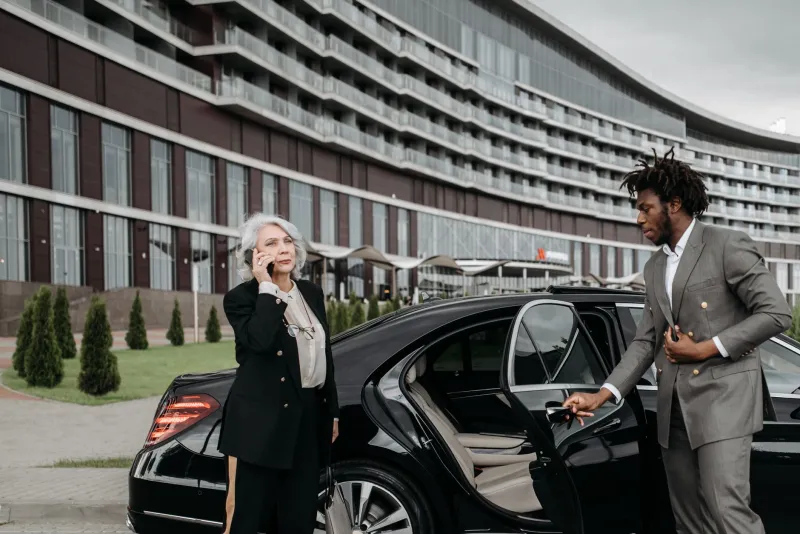
The journey begins before the engine does. A car waiting with its door already open is a courtesy; a passenger who appears at the appointed minute is the matching half of it. The distinction between five minutes early and five minutes late is rarely about inconvenience to the driver — a good chauffeur builds slack into the day as a matter of course — but about the shape of the journey itself. Arrive flustered, and the first ten minutes are spent recovering. Arrive composed, and the car absorbs you into its own slower rhythm.
For departures with a fixed deadline — a flight, a board meeting, a table booked for one — the sensible habit is to agree the collection time the evening before rather than the morning of. Confirmations sent at 7am tend to arrive alongside a dozen other demands on the day.
The address, given once
The address is information, not conversation. Give it clearly at the point of booking, and again on the day only if it has changed. Beyond that, there is no need to explain the neighbourhood, warn about the one-way system or describe the building. A chauffeur who knows Mayfair will know that Mount Street presents differently from Park Lane, and will have planned accordingly.
Discretion runs through this like a thread. Passengers who conduct sensitive calls in the rear seat are not being overheard, and they are not being assessed. The same holds for the destinations themselves — whether a private members' club, a clinic, a solicitor's office or a house in the country. A professional car does not require a reason for the journey, and a professional passenger does not supply one.
Reading the silence
Conversation is offered, never imposed. The opening exchange is nearly always the same — a greeting, a confirmation of destination, perhaps a word about the weather — and what follows is a matter of reading the room. A folded newspaper, an open laptop or a phone raised to the ear are all perfectly legible signals. So, in fairness, is an unanswered question.
For passengers who welcome company, the rewards are considerable. Drivers who work this city daily accumulate a working knowledge of it that no guidebook matches: which entrance is actually used at a given hour, where the traffic will gather on a Friday afternoon, which stretch of pavement stays dry under the awning. The conversation is worth having when there is time for it.
The question of the front seat
A single passenger travelling alone need not feel obliged to sit in the front, and equally need not apologise for sitting in the back. The rear compartment is the point of the vehicle. Where a party numbers three or more, the arrangement tends to sort itself, though the instinct to offer the most comfortable seat to the eldest or most senior guest remains sound.
Preferences, stated early
Almost every adjustable element of a journey can be changed, provided it is raised in the first few minutes and not the last few. Temperature is the commonest example: a car warmed for a winter morning will be too warm for one passenger and precisely right for another. The same applies to the radio, the route, the pace and the question of whether the journey should include a pause.
Requests made at the outset are treated as planning. Requests made at a red light on Park Lane are treated as improvisation — often managed, but never as elegantly.
The clock belongs to the passenger
Waiting is part of the service, within reason. A driver will hold position through a delayed meeting, a long lunch or an unanticipated detour, but the arrangement works best when it is understood in advance rather than discovered. A simple message — fifteen minutes more — costs nothing and preserves everything.
Equally, the passenger's time is the driver's responsibility. If a route is chosen, it is chosen for a reason; if a departure time is recommended, it is recommended against a known pattern of congestion rather than a general preference for earliness.
Closing the journey
A gratuity is discretionary, and the discretion is best exercised quietly. The most graceful version is a folded note passed at the door with a word of thanks, rather than a negotiation conducted through a card reader on a residential street. Where a journey has been arranged through an account, the matter is settled in the invoice and no further gesture is required.
Then the door closes, and the car pulls away, and nothing about the arrangement should linger. That, in the end, is the only rule worth remembering: the finest chauffeured journeys leave no residue — no fuss at the kerb, no conversation to recover from, no detail to chase. Just a door, a seat, and a city going past at a civilised distance.