The Correct Threshold: Chauffeured Arrivals at London’s Grand Hotels in 2026
An arrival at one of London’s grand hotels is rarely merely a drop-off. It is a sequence of small judgments: which kerb to use, when to step out, who takes the cases, and how quickly the street gives way to a quiet interior. For a chauffeur, the objective is not to make an entrance. It is to make the entrance disappear.
At Mayfair Drives Ltd, our private journeys often end at Claridge’s, The Connaught, The Savoy, The Berkeley or The Lanesborough. Each has its own geometry and its own habits. The following guide is intended for travellers who value discretion over display, and for those who would rather the hotel noticed them only when they wished to be noticed.
The door is part of the journey
London’s grand hotels are not uniform in the way they receive cars. Claridge’s has its principal arrival on Brook Street, with Davies Street occasionally useful when Brook Street is congested—though only if the hotel has been told and the concierge is expecting the car. The Connaught is approached from Carlos Place, a quiet cul-de-sac off Mount Street; the chauffeur should avoid blocking its throat while waiting. The Savoy’s vehicular arrival is through Savoy Court, off the Strand, rather than the Strand frontage itself. The Berkeley is best approached from Wilton Place, not from the rush of Knightsbridge. The Lanesborough sits at Hyde Park Corner, with its arrival at Lanesborough Place, a spot that rewards a driver who knows the traffic sequence rather than one who improvises.
These details matter because a wrong turn at the final fifty yards can undo an otherwise polished journey. A good chauffeur does not simply know the postcode. He knows which side of the building takes luggage, where the car may pause, and which approach keeps the passenger out of the weather and away from a queue of taxis.
Timing is a form of courtesy
For a leisure stay, late morning—between about 11.00 and 12.30—is often calmer than the 15.00 check-in peak. The lobby may still be active, but it is usually less compressed. For dinner, aim to arrive ten to fifteen minutes before the reservation, not half an hour. A premature arrival can leave a guest standing in precisely the crowded reception they had hoped to avoid.
Friday and Saturday evenings in Mayfair and Knightsbridge are not the moment for an unscheduled arrival. If you are attending a private event, ask the hotel for the recommended arrival window; a good concierge will know when the lobby is likely to be busy and when the lifts are under pressure. In 2026, with London’s event calendar as dense as ever, that small inquiry is worth more than a grand gesture.
Luggage, without the pantomime
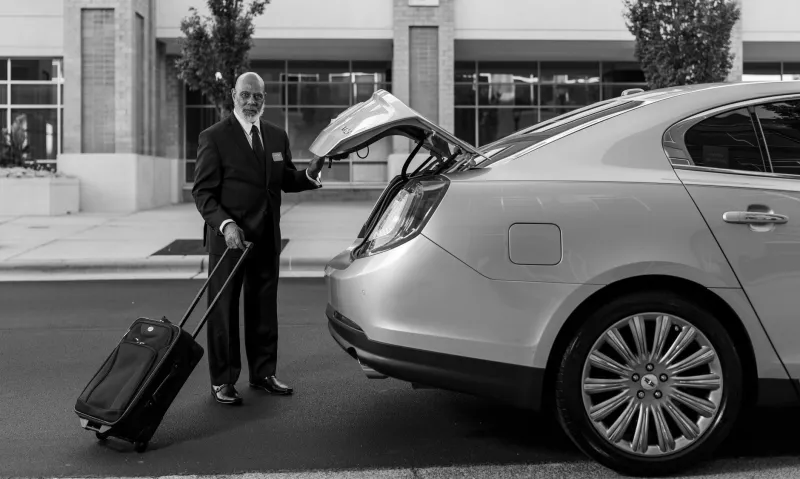
The choreography begins before the car stops. The chauffeur should know the number of cases, who will meet them, and whether any item must stay with the passenger. On arrival, luggage is handed to the concierge or door staff—not to the lobby floor, and not to a porter who has not been expecting it. Essentials such as documents, medication and a coat remain in the rear compartment until the passenger is ready to step out.
There is a temptation, particularly after a long flight, to carry everything oneself. It slows the arrival and creates clutter at the very point where calm is most valuable. Better to let the hotel do what it is designed to do: receive. For departures, cases should be brought down before the car is called. The car should not wait at the kerb longer than necessary, and the passenger should not be left standing in the entrance while a bill is settled.
The lobby is not the destination
A crowded lobby is not a crisis, but it is avoidable. Ask in advance whether a quieter entrance or private reception is available. At some hotels it is; at others it is not. The request should be made before the day of arrival, never at the door. If the room is not ready, the car can serve as a waiting room. A short pause in a quiet rear seat is preferable to standing beside reception with luggage at one’s feet.
It is also worth resisting the urge to have the chauffeur announce you. The concierge can do that with greater discretion and less theatre. The passenger should be able to move from car to desk to lift with as few interruptions as possible. That is the real luxury of a grand hotel arrival: not the spectacle, but the absence of friction.
The return journey sets the tone
A hotel arrival is only half the story. The departure should be arranged with the same care. Confirm the car’s pickup point with the concierge, allow for the hotel’s own rhythm of luggage and lifts, and build in a margin for London traffic. The best arrivals are remembered not because they were dramatic, but because they were effortless. In a city of grand thresholds, the correct door is the one that lets the journey end quietly.