The Discreet Companion: A Chauffeured Guide to London with a Dog in 2026
A chauffeured car is, at its best, a private room that happens to move. Add a dog and the room acquires a second personality: warmer, more animated, and considerably less forgiving of poor planning. London in 2026 is a more welcoming city for dogs than it was a decade ago — pubs, hotels and even a number of shops have softened their positions — but the practicalities of moving an animal through the capital by car remain quietly demanding. The following notes cover what experience suggests is worth attending to before the boot closes.
The Conversation That Should Happen First
Most difficulties with dogs in cars are settled, or created, at the point of booking. Size and breed matter less than temperament, age and how the animal travels: a nine-year-old whippet who sleeps from departure to arrival is a different proposition from a four-month-old spaniel on his first long journey. Guests are well advised to say plainly whether the dog travels in a crate, wears a harness secured to a seat belt, or has never been in a vehicle for longer than twenty minutes. Two dogs, a large crate and a fortnight's luggage will not fit comfortably into a standard executive saloon, and discovering this on the morning of departure serves nobody.
It is also worth mentioning the destination. A veterinary practice in Belgravia with a narrow forecourt, a country house hotel with a gravel sweep, a private aviation terminal with its own arrival protocols — each shapes the vehicle chosen and the time allowed.
Preparing the Cabin, Not Merely Cleaning It
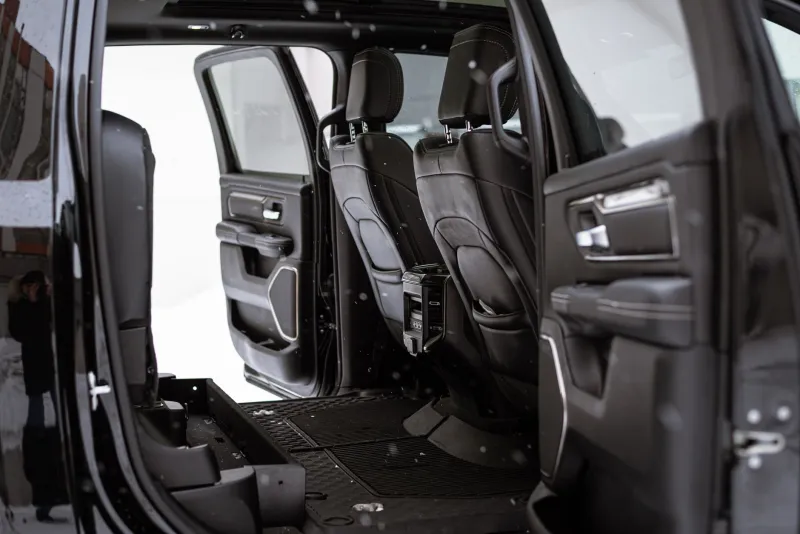
A car that has carried a dog should never announce the fact to the next passenger, and preparation begins well before the day itself. A fitted, non-slip liner across the rear bench or boot floor protects leather and gives paws something to grip; a secured crate or a crash-tested harness prevents the animal from becoming a projectile under braking. A mesh guard between the load area and the cabin is sensible for larger dogs, and a dog should never travel on the front seat, where a deploying airbag poses real risk.
Smaller considerations repay the effort. Ventilation should be adjusted for the dog rather than the passenger — cool, moving air, never a draught directly onto the face. A heavy ceramic bowl is a nuisance in a moving car; a shallow travel bowl or a lidded bottle is better. A towel, a blanket carrying the scent of home and a supply of waste bags complete the kit. For journeys of any length, the climate control should be set before collection so the cabin is neither stifling nor cold on arrival.
Morning Rituals: Parks and Their Gates
A dog accustomed to a Hyde Park morning will expect it in London, and the arrangement is easily kept. The park's perimeter gates along Park Lane and Knightsbridge allow a drop at the pavement with a short walk to open grass; dogs are welcome but should be under close control, and leads are generally required near roads and in sensitive areas — signage at each gate sets out the current position. Battersea Park, reached conveniently across Chelsea Bridge, offers a similar rhythm, while Hampstead Heath suits those staying north of the river, with roadside access off East Heath Road.
Route planning in central London is largely a matter of avoiding the wrong half-hour. The 20 mph limit and the capital's bus gates do not trouble a chauffeur, but a dog does not benefit from twenty minutes of stop-start traffic on the Embankment at nine in the morning. A slightly longer line through the park's edge is often the kinder one.
The Veterinary Appointment
Few journeys are watched more closely by an animal than the one to the vet, and few are more improved by a chauffeur. Practices in Marylebone, Knightsbridge and the Harley Street quarter have limited forecourt space; arriving on time and being met at the door removes the traditional ordeal of circling. For referral work — the Queen Mother Hospital for Animals at Hawkshead, for instance, or the larger practices south of the river — the journey may be forty minutes or more, and an early appointment is worth the alarm clock. A dog that has been walked briefly and has emptied itself before departure travels far better, and a harness rather than a collar is the prudent choice for a dog likely to be handled on arrival.
Weekend Escapes and the Long Leg
Beyond London, the car comes into its own. The Cotswolds sit roughly two hours from Mayfair; Hampshire and the New Forest a little more; the Surrey Hills barely an hour. On longer runs, a break every ninety minutes or two hours is kind to both dog and driver, and service areas on the M4 and M3 now generally offer a strip of grass. A dog should never be left in a stationary car on a warm day, and on a cold one the same rule is safer than any calculation about shade and duration.
Crossing Hotel Thresholds
London's pet-friendly hotels — the Egerton House in Knightsbridge, the Milestone in Kensington, several of the larger houses in Bloomsbury and the City — each set their own terms, and it is unwise to assume. Size limits, nightly charges, which public rooms admit dogs, whether a lift may be used, and whether a member of staff will walk the animal are all questions best asked at the time of booking rather than at the desk. Country houses tend to be more relaxed, but a request to dine with a dog in the main restaurant will usually, and reasonably, be declined.
The Return, and the Small Courtesies
By the final evening the dog is often tired, occasionally muddy, and always ready for the last walk of the day. A towel by the boot, a bowl of water on arrival, and a few minutes on the pavement before the door closes make the difference between an ending and an anticlimax. Where a return is expected well after midnight, it is worth asking honestly whether the animal might be happier at home — a judgement the household is better placed to make than the driver.
A well-mannered hound and a well-prepared car are, in the end, the same thing: both the product of forethought rather than improvisation. Attend to the details in advance and the journey becomes what it should be — unremarkable, in the most complimentary sense of the word.