The Eastern Shortcut: A Chauffeur's Honest Verdict on London City Airport in 2026
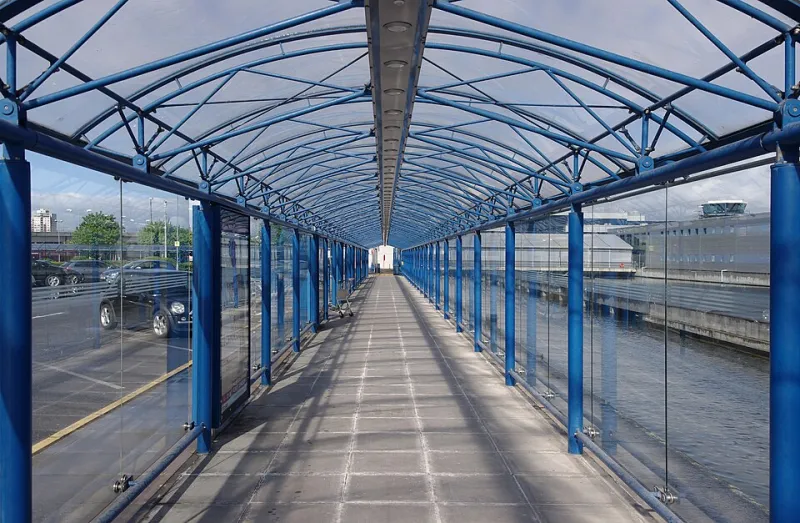
Photo: mattbuck (category), CC BY-SA 3.0, via Wikimedia Commons
There is a particular journey for which London City Airport is not simply convenient but plainly correct: one traveller, one cabin bag, a European city within two hours' flying time, and a diary that punishes a wasted morning. For almost every other journey, the argument dissolves within a minute of honest scrutiny. What follows is an attempt to be precise about which is which, drawn from the seat rather than the departure board.
The arithmetic, done from a Mayfair doorstep
Distances in London are a poor guide to time, but they are a starting point. From Mount Street or Grosvenor Square to the Royal Docks is roughly nine miles; to Heathrow, closer to eighteen. In ordinary conditions — a Tuesday at half past seven, say — a chauffeur will reach London City in twenty-five to thirty-five minutes, running east through the City, into the Limehouse Link and out along the A13. The same morning will put a car at Heathrow in forty-five to seventy minutes, with the M4 elevated section and the Chiswick roundabout as the usual points of negotiation.
That is a saving of twenty to forty minutes on the outward leg alone, and it is a saving of a different quality from the ones usually promised in travel writing. It is not a saving of comfort. It is a saving of the hour in which nothing can be done.
Kerb to gate, without ceremony
The advantage of London City is not that it is luxurious; it is that it is small. The forecourt sits perhaps a hundred and fifty metres from the security search area. A driver draws up, hands over the cabin bag, and the passenger walks — indoors, on the level — into the terminal. There is no transit train, no people-mover, no concourse the length of a football pitch, and no decision about whether to walk or wait.
For the chauffeur, the choreography is equally simple. The drop-off is at the terminal itself rather than in a remote short-stay car park; the car is unloaded and away in under a minute, and there is no need to build a ten-minute buffer for a shuttle bus that may or may not appear. On the return, the car can be brought to the forecourt as the aircraft lands, because the walk from gate to kerb is measured in minutes and the baggage hall, for cabin-bag passengers, is a corridor they simply pass.
The airport's own guidance is to allow ninety minutes. In practice, a hand-luggage passenger arriving forty-five minutes before departure rarely hurries, and one arriving thirty minutes before is not yet anxious. Those figures are not marketing; they are the product of a terminal with eight or so gates and a single security hall.
What the airport cannot do
Honesty requires the caveats, and at London City they are structural rather than occasional.
The first is the weekend. The airport keeps a deliberate silence: operations cease shortly after midday on Saturday and do not resume until Sunday afternoon. A Saturday-evening departure to Zurich, or a Sunday-morning flight to Edinburgh, is not a matter of choosing another airline — it is not available at all. Anyone whose travel falls into that window is travelling from Heathrow, Gatwick or the private terminal at Farnborough, and no amount of kerbside convenience will change it.
The second is the aeroplane. The runway is short and the approach steep, which restricts the field to narrow-body jets and turboprops on sectors of roughly two hours or less. Amsterdam, Frankfurt, Zurich, Geneva, Milan, Dublin, Edinburgh and a seasonal spread of Mediterranean destinations are well served. New York, Dubai and Singapore are not, and never will be from this runway.
The third is frequency. A carrier operating four rotations a day to a city will offer less flexibility than one operating twelve, and business travel has a habit of changing at four o'clock in the afternoon.
The cabin-bag calculation
The journeys where London City quietly wins are almost always the same shape: one night, one bag, one meeting. The absence of checked luggage removes the carousel from the equation entirely, and with it the last structural reason to arrive early. A passenger who lands at half past nine can be in a car on the A13 by twenty to ten and at a Mayfair desk before eleven — a sequence that Heathrow, with its piers and its trains, cannot match at any price.
There is also the matter of the drive itself. The eastern route has a certain interest that the M4 does not: the City, the river at Limehouse, the towers at Canary Wharf and then the water of the Royal Docks. A passenger who works in the City can look out of the window at the district they are about to spend the day in. It is a small thing, but it is not nothing.
When Heathrow, or a private terminal, remains the better call
Heathrow wins decisively wherever the journey is long, the party is larger, or the luggage is real. A family of four with hold bags, a traveller connecting to a transatlantic service, anyone requiring an alliance lounge or a wide choice of departure times — all of them are better served to the west. The same applies to early-morning departures to the Middle East and North America, where London City has no offering at all.
There is a third option for those who value the threshold more than the timetable: the private terminal at Farnborough, reached from Mayfair in about an hour, where the car draws up beside the aircraft and the terminal is a room rather than a hall. For a small party with a European meeting and no wish to share a security queue, it remains the most composed departure available from London.
The verdict
For a short European sector, midweek, with hand luggage only and a schedule that will not forgive, London City is the correct choice and the chauffeur should be directed east. For weekends, for long-haul, for connections and for anything requiring a hold bag the size of a small trunk, Heathrow remains the honest answer — and a well-planned car will make it tolerable.
The rule we offer clients is simple: if the flight is shorter than the drive, take the eastern route; if the flight is longer, leave earlier and go west.